


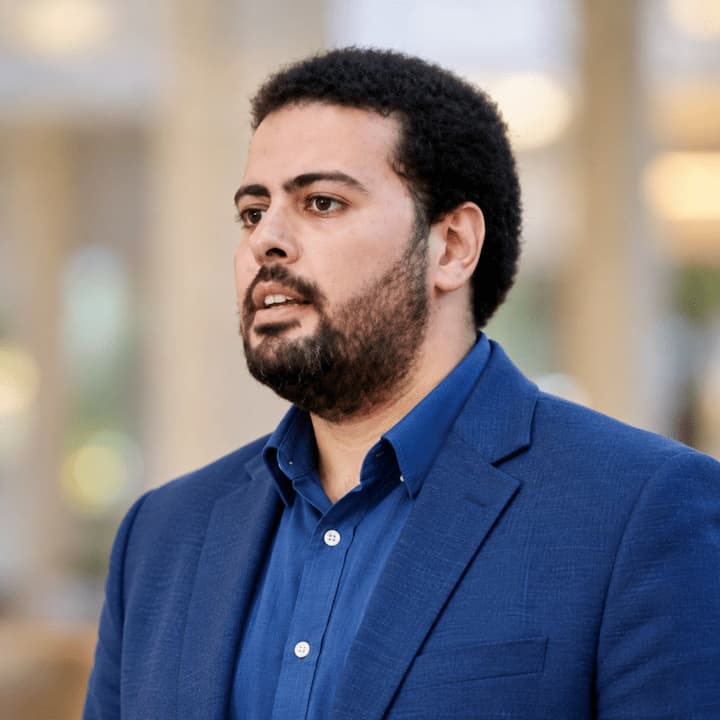
Muhammad Omar, DVM, PhD profile and information
Learn more about Muhammad Omar, DVM, PhD
- Post-Doctoral Fellow
mgo0038@auburn.edu
260 Lem Morrison Dr. R-0117
Google Scholar
Muhammad Omar, DVM, PhD LinkedIn
Download CV
More bio information
Short Bio
I am a Postdoctoral Fellow in the Department of Nutritional Sciences at Auburn University. My current research focuses on understanding how obesity and metabolic dysfunction influence colorectal cancer progression, the tumor microenvironment, and metastasis. I have a multidisciplinary background in cancer biology, immunology, metabolism, molecular biology, and veterinary medicine. I earned my PhD in Integrative Biomedical Sciences from Tuskegee University, where my doctoral research focused on developing CAR-T targeted immunotherapeutic approaches for triple-negative breast cancer.
Education
PhDTuskegee University, USA2025
M.V.S.Cairo University, Egypt2018
Doctor of Veterinary Medicine (DVM)Sadat City University, Egypt2011
Professional Experience
My research experience spans cancer biology, immunology, molecular biology, virology, and translational biomedical research. I currently work as a Postdoctoral Fellow at Auburn University, where I investigate obesity-associated colorectal cancer and the interactions between cancer cells and their surrounding microenvironment using in vitro, in vivo, and patient-derived models.
During my doctoral training at Tuskegee University, my research focused on cancer immunology and targeted therapeutics, particularly antibody discovery using phage display and the development of CAR-T cell approaches for triple-negative breast cancer. Before my doctoral studies, I conducted research at the National Research Centre in Egypt, where my work included molecular virology, immunogenetics, and host genetic factors associated with susceptibility to viral diseases.
Innovation
My research interests lie at the intersection of cancer, metabolism, and immunology. My current work focuses on understanding how obesity and metabolic alterations reshape the colorectal cancer tumor microenvironment and contribute to cancer progression and metastasis.
I am particularly interested in developing translational models that better represent the complexity of human cancer. My work incorporates patient-derived tumor samples, organoids and xenografts, 3D tissue-engineered models, tumor–stromal and tumor–immune interactions, metabolic phenotyping, and preclinical animal models. My broader research interests include obesity-associated cancer, colorectal cancer, tumor immunology, cancer metabolism, chemokine signaling, metastasis, patient-derived cancer models, CAR-T cell therapy, antibody discovery, and precision oncology.
Engagement
I am passionate about mentorship, scientific education, and community engagement. Throughout my academic and research training, I have worked with students and trainees from different backgrounds and have contributed to mentoring in laboratory research, experimental design, scientific communication, and professional development.
I also value opportunities to communicate science beyond the laboratory and to support educational and community activities that encourage student development and interest in science and biomedical research.
Education & Training
My academic and research training has provided me with a multidisciplinary background in veterinary medicine, virology, immunology, molecular biology, and cancer research.
I earned my Doctor of Veterinary Medicine (DVM) degree from the University of Sadat City in Egypt, followed by a Master of Science in Veterinary Medical Sciences with a focus on Virology and Immunogenetics from Cairo University. During my graduate training, I also gained international research experience through visiting research programs at the University of Limoges in France and Yangzhou University in China.
I later earned my PhD in Integrative Biomedical Sciences from Tuskegee University, where my doctoral research focused on cancer immunology and the development of targeted immunotherapeutic approaches for triple-negative breast cancer, including antibody discovery and CAR-T cell engineering.
I am currently completing my postdoctoral training in the Department of Nutritional Sciences at Auburn University, where I am expanding my expertise in cancer metabolism, obesity-associated colorectal cancer, tumor microenvironment biology, patient-derived cancer models, and translational oncology.
Honors, Awards & Recognition
I have received several awards and competitive professional development opportunities recognizing my research and scientific training. These include the 1st Place Award at Southern Research’s “Moving Science with STEM Stars” (2023), the Institutional Champion Award from the NIH All of Us Researcher Academy (2023), and the Scientific Excellence Award from the Center for Clinical and Translational Science (CCTS) at UAB (2022).
I was also selected as a Science for Development Institute (SCI4DI) Scholar through USAID/Duke University in 2024 and participated in the NIH-NCI-supported Summer Cancer Research Education Program (SCREP) in 2023. My international research training has also included programs at the University of Limoges in France and Yangzhou University in China.

